
If you have been handed a problem and told to go investigate, the mind mapping technique in business analysis is often the best place to start before you talk to a single stakeholder. It stops you arriving at an interview or workshop with assumptions already baked in. Instead of going in with a mental model shaped by whoever briefed you, you use a mind map to lay out everything you know, everything you suspect, and every category of factor that could be relevant. Then you let the structure show you what you are missing.
I have used mind maps across government, utilities, health, and enterprise environments, and the pattern is almost always the same. Someone frames a problem as a solution (“we need a new system”) and my job is to slow that down long enough to find out whether the framing is right. A mind map is the fastest tool I know for doing that in a way that feels structured rather than obstructive.
What a Mind Map Actually Does in a BA Context
A mind map starts with a central idea, usually the problem or the stated need, placed in the middle of the page. From there, you radiate outwards with related ideas, categories, contributing factors, and questions. There are no rules about what goes where. The value is in the externally visible thinking, not the tidiness of the output.
Where mind mapping earns its place in the BA toolkit is in the early stages of a project, before you have committed to a direction. It is equally useful in a workshop setting, in a one-to-one interview, or as a personal thinking exercise before you walk into a room. It complements structured techniques like fishbone analysis and the five whys by helping you cast the net wide before you narrow down to root causes.
You do not need specialist software. I have used FreeMind, Miro, and Sparx Enterprise Architect on different projects. I have also used a whiteboard with sticky notes and a photograph taken on a phone afterwards. Visio and PowerPoint work perfectly well if that is what your organisation has. The tool matters far less than the discipline of actually doing the exercise before you start writing requirements.
The Three Steps I Follow Every Time
Step 1: Put the Central Problem in the Middle
The central idea should be the problem as it has been stated to you, not your interpretation of it. If someone says “we are getting too many product bugs reported by customers,” that phrase goes in the centre, verbatim. Resist the urge to reframe it before you have explored it. The mind map will do that work for you.
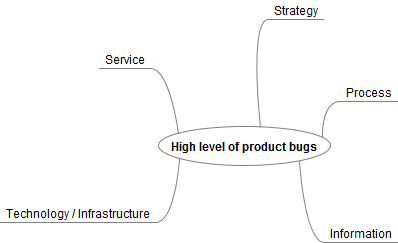
Step 2: Add Six Category Branches
To avoid staring at a blank page, I use six categories drawn from standard architecture thinking: strategy, service, process, applications, information, and infrastructure. Each one becomes a branch radiating from the centre. These categories are broad enough to be universal and specific enough to prompt real thinking. They give you a scaffold without constraining your ideas.
Step 3: Brainstorm Under Each Category Without Filtering
Under each category, write down everything that could be contributing to the problem. Do not edit as you go. Do not evaluate whether something is relevant. The filtering, reordering, and culling comes later. The goal of this phase is to get everything out of your head and onto the page. A focused twenty-minute session usually produces enough material to structure a full workshop agenda or a set of targeted interview questions.
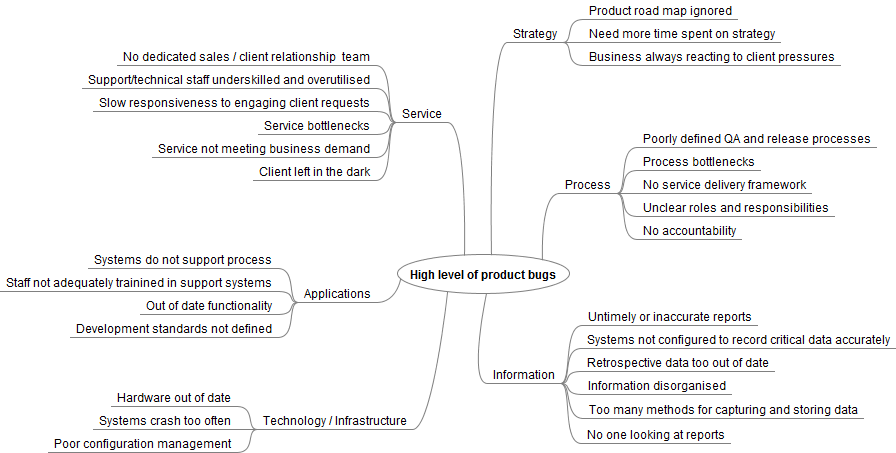
Once the initial brainstorm is complete, you will almost always find that one or two branches have generated enough material to become their own central concepts for further analysis. That is the point at which a mind map transitions from a broad exploration tool into a focused problem-solving exercise.
A Real Example: When the Map Revealed the Actual Problem
On Project X, I was brought in part-way through a scoping phase. The business had already stated clearly that they needed a new bug management system. A vendor had been shortlisted. The project manager was keen to move quickly because the delivery timeline was tight.
Before I agreed to start writing requirements for a new system, I asked for two hours with the product team to run a mind mapping session. The central concept was “high volume of bugs reported by customers.” We mapped across all six categories. Under the process branch, the team identified that there was no formal QA sign-off before releases went live. Under applications, we found the existing bug tracking tool was only being used by two of the five development teams. Under information, we found there were no agreed defect severity categories, so everything was being logged at the same priority level.
The project manager pushed back on this. His position was that we had already decided to procure a new system and that my job was to gather requirements for it, not to reopen the problem definition. It was an uncomfortable conversation. I acknowledged the timeline pressure and agreed to run both tracks in parallel: I would continue the problem exploration while someone else began drafting the procurement brief. What the mind map had surfaced, though, was enough to take to the sponsor. Within a week, the decision to procure was paused while a process review was commissioned. The eventual outcome was a reconfiguration of the existing tool and a revised release process, at a fraction of the projected procurement cost.
The mind map did not make that decision. But it created the conditions for the right question to be asked at the right time, before the organisation committed to an expensive solution for a problem it had not fully defined. This is exactly the kind of situation the BA problem solving framework is designed to support.
When to Use a Mind Map vs Other Problem Exploration Tools
| Technique | Best Used When | Limitation |
|---|---|---|
| Mind Map | You need to explore a problem broadly before narrowing focus | Does not surface cause-and-effect relationships directly |
| Fishbone (Ishikawa) | You have a specific outcome to explain and want to trace contributing causes | Requires you to already know what you are explaining |
| Five Whys | You have identified a symptom and want to drill to root cause | Can become linear and miss parallel contributing factors |
| SWOT Analysis | You are assessing an organisation or solution option | Not well suited to open problem exploration |
| Process Mapping | The problem is suspected to lie within a specific workflow | Requires existing process knowledge to be useful |
How to Get the Most Out of a Mind Mapping Session
- Start with the problem statement, not a solution: The central concept should always describe what is wrong or what is needed, not what has already been proposed as the fix.
- Use the six categories as a prompt, not a constraint: If something important does not fit neatly into strategy, service, process, applications, information, or infrastructure, add it anyway and label it accordingly.
- Run the session before your first stakeholder interview: A completed mind map gives you a hypothesis about where the gaps are, which makes your interview questions sharper and more focused.
- Use any branch as a new central concept: If a single branch generates a lot of material, pull it out into its own map and go deeper. This is how you move from surface exploration to genuine root cause analysis.
- Save the reordering for after the brainstorm: Editing as you go kills ideation. Write everything down first, then evaluate.
- Pair it with structured elicitation: A mind map is a thinking tool, not a requirements tool. Once you have explored the problem, you still need to move into formal elicitation techniques to capture what stakeholders actually need.
Adapting Mind Mapping for Workshops and Group Sessions
When I run mind mapping in a workshop, I put the central concept on a shared screen or a physical whiteboard and invite participants to call out ideas while I map in real time. The important facilitation rule is the same as when working alone: no evaluation during generation. If someone says something that seems tangential, add it. The group often builds on apparently unrelated ideas to reach something genuinely useful.
In a remote workshop, Miro works well because multiple participants can add sticky notes simultaneously, and you can cluster and theme them afterwards. In a room, a large whiteboard or a wall covered in sticky notes achieves the same result. What matters is that the output is visible to everyone while it is being created. Shared visibility changes the quality of the conversation because people respond to what they see, not just to what is being said.
If you are working with a group that is resistant to open-ended brainstorming, framing the six categories upfront gives them enough structure to feel safe. I have found this particularly useful in technical teams who default to solution-thinking. Asking “what process factors might be contributing to this problem?” is a more productive prompt than “what do you think is causing this?” For more on running sessions like this effectively, the guidance on BA facilitation skills is worth reading alongside this technique.
Mind mapping works because it externalises thinking before it hardens into assumptions. In over two decades of BA work, I have consistently found that the projects which run into trouble late in delivery are the ones where the problem definition was accepted too quickly at the start. A mind map takes twenty minutes and costs nothing. The problems it surfaces early are the ones that would otherwise cost weeks to unpick after requirements have already been signed off.
Frequently asked questions
What is mind mapping in business analysis?
Mind mapping in business analysis is a visual technique for exploring a problem or idea by placing a central concept in the middle of a page and branching out with related factors, categories, and questions. It helps analysts think broadly before narrowing down to requirements or solutions. It is particularly useful in the early stages of a project before stakeholder interviews or workshops begin.
How do you create a mind map for a business analysis project?
Start by writing the problem or central idea in the middle of the page, then add branches for each major category of factor that could be relevant, such as strategy, process, applications, information, and infrastructure. Under each branch, write down everything that might be contributing to the problem without filtering or evaluating as you go. Once the brainstorm is complete, review and organise the output to identify areas that need further investigation.
What tools do business analysts use for mind mapping?
Common tools include FreeMind, Miro, Sparx Enterprise Architect, Visio, and PowerPoint. A physical whiteboard or sticky notes work equally well in a workshop setting. The choice of tool matters less than the discipline of completing the exercise before committing to a requirements direction.
When should a business analyst use a mind map instead of a fishbone diagram?
Use a mind map when you need to explore a problem broadly and have not yet identified the likely causes. Use a fishbone diagram when you have a specific outcome to explain and want to trace contributing factors in a structured cause-and-effect format. Mind mapping is better suited to the very early stages of problem exploration.
Can mind mapping replace requirements elicitation?
No, mind mapping is a thinking and exploration tool, not a requirements capture tool. It helps you identify what questions to ask and where the gaps in understanding are, but you still need formal elicitation techniques to gather and document what stakeholders actually need. Think of it as preparation for elicitation rather than a substitute for it.
Try Ash, Your Virtual BA
If this mind mapping session has helped you clarify the problem you are working on and you are now ready to move into requirements, Ash can help you take the next step. Ash is a virtual BA assistant built specifically for business analysis work, and it can guide you through structuring your findings, framing your problem statement, and producing a solid requirements document without starting from a blank page. Give it the context you have uncovered and let it help you move from exploration to output. Try Ash Virtual BA.
Further reading
- 10.29 Mind Mapping | BABOK® Guide
- Fun and Learning: The Soft Side of Business Analysis | Analyst Catalyst Blog
Written by Sam Cordes, founder of the Business Analyst’s Toolkit.